

How particle capture works
What Is Mechanical Filtration?

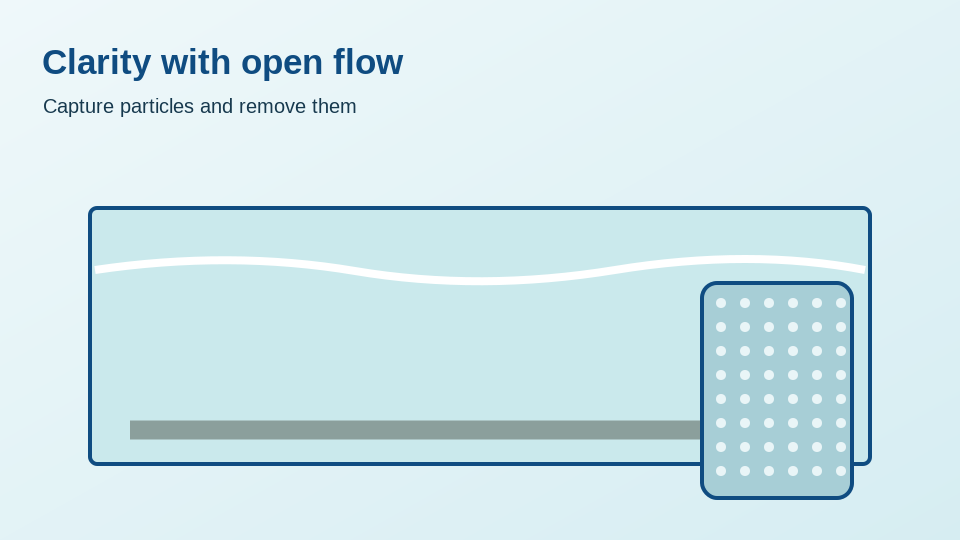
Think of a kitchen strainer or coffee filter. Water moves through openings while particles larger than the openings are intercepted. Aquarium mechanical media works on the same physical principle, though its fibers and pores may also catch some particles through contact within a thicker pad. It is a separation process, not a chemical treatment.
Fish feces, leftover food, dead leaves, mulm, loose algae, and suspended substrate dust can be caught if they reach the filter intake. “Mulm” means the mix of fine decomposing material that accumulates around plants and substrate. The filter cannot collect a particle that remains trapped behind a rock or settled deep inside gravel without being moved into the water path.
Mechanical Filtration Does
- Capture particulate waste in a removable location.
- Improve clarity when suspended solids cause haze.
- Reduce the amount of debris reaching downstream media.
- Make collected solids easier to rinse or discard.
Mechanical Filtration Does Not Directly
- Convert ammonia into nitrite or nitrite into nitrate.
- Remove every dissolved substance from aquarium water.
- Replace partial water changes and routine cleaning.
- Catch waste that never enters the filter's water stream.
Some trapped organic matter would otherwise have broken down elsewhere in the tank. If it is removed from the media promptly, less of that particular material remains to decay in the system. That is an indirect benefit, not evidence that an ordinary foam pad removes dissolved ammonia.
The capture rate depends on the media and the water route. A very fine sheet may trap tiny particles but slow down quickly. A coarse sponge can pass smaller particles while holding larger waste for longer. A useful mechanical stage balances the size of what you want to catch with the flow the aquarium still needs.
How Does Mechanical Filtration Work?
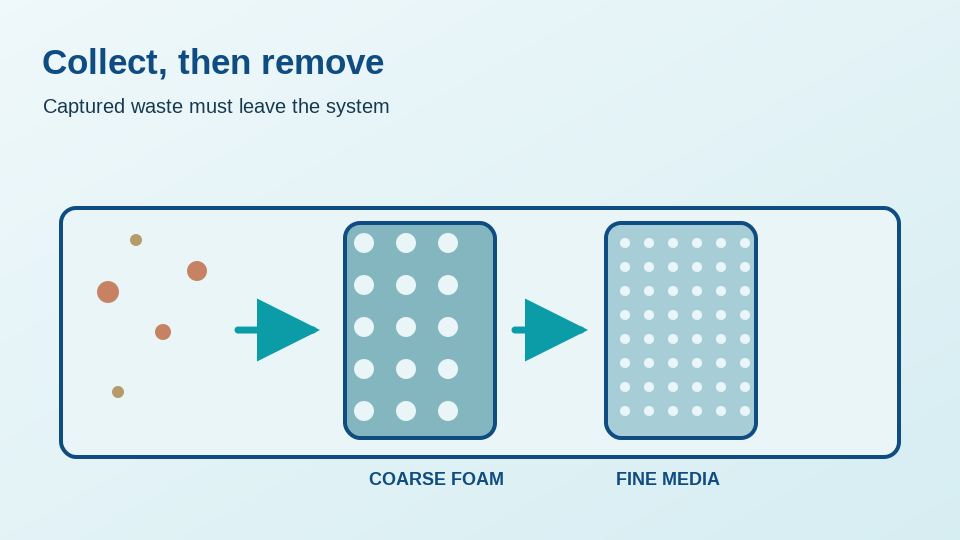
For the filter to do useful work, aquarium water must carry particles into its intake and through the medium rather than around it. A pump or airlift provides the movement. Pores and fibers then intercept solids while water continues through the filter and returns to the tank.
- Suspended debris enters the filter with aquarium water.
- Water meets a mechanical sponge, pad, floss, sock, or similar medium.
- Larger particles lodge on or within the porous structure.
- Water continues through other filter stages.
- Collected debris stays in the mechanical medium.
- The keeper rinses, cleans, or replaces loaded media as appropriate.
- That service physically exports collected waste from the system.
Step six is crucial. A mechanical filter is a waste-collection system, not a waste-destruction system. Organic solids left in a wet filter can keep decomposing, so a pad that looks full has done only the first part of its job. Routine service completes the removal.
Imagine a few extra food pellets drifting into a filter. A coarse sponge catches them before they scatter behind hardscape. If you rinse that sponge and discard the dirty rinse water, you remove the pellets. If you leave the sponge untouched while the food rots, it may still contribute dissolved waste to the aquarium.
The filter's intake and aquarium circulation also matter. Particles that settle immediately may need a gravel cleaner or careful spot cleaning rather than a denser filter pad. Increasing flow enough to move every speck is not always suitable for fish or plants, so combine a sensible filter path with normal tank maintenance.
Watch for bypass: water taking a route around a clogged or poorly seated pad. A filter may still pour water from its outlet while much of that flow avoids the material intended to catch debris. Correct the seating and clean the obstruction before adding more media.
Types of Mechanical Filter Media

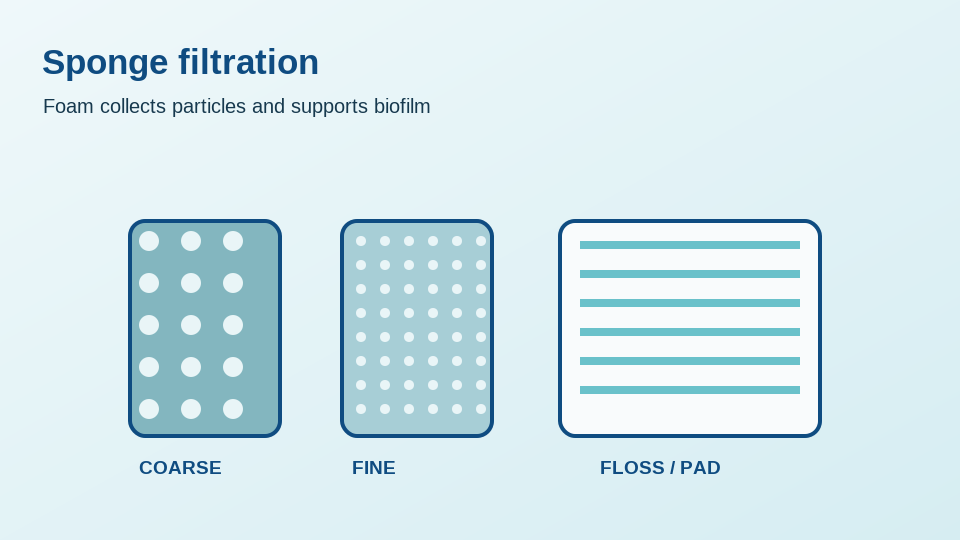
There is no single best medium for every size of particle or style of filter. Coarse material usually stays open longer and catches larger debris. Fine material can polish visible haze, but it loads faster and needs closer attention. “Fine” describes its capture behavior; it is not automatically a higher-quality choice.
| Medium | Capture | Clogging | Reuse | Typical role |
|---|---|---|---|---|
| Coarse sponge or foam | Larger particles | Usually slower | Often reusable | Early capture and pre-filtering |
| Fine sponge or foam | Smaller solids | Usually faster | Often reusable | Secondary capture |
| Filter floss | Very fine suspended particles | Can be rapid | Product dependent | Water polishing |
| Polishing pad | Fine particles | Often rapid | Product dependent | Final clarity stage |
| Filter sock | Particles above its mesh opening | Load dependent | Often washable | Sump inlet capture |
| Roller mat | Solids on moving fleece | Fresh fleece advances | Roll often replaced | Automated or semi-automated capture |
| Intake pre-filter sponge | Coarser intake debris | Load dependent | Often reusable | Protects intake and small animals |
Coarse and fine foam
Coarse foam has larger openings and is useful early in the water path. It captures food fragments, leaves, and larger waste without filling as quickly as a dense pad. Fine foam intercepts smaller solids after much of the large debris is removed, but needs more frequent checks when the tank sheds many particles.
Floss, polishing pads, and socks
Filter floss and polishing pads are used for small suspended particles. Their density differs by product, so inspect the instructions for cleaning or replacement. Filter socks are common at sump inlets, especially in marine systems; a smaller micron opening can capture finer particles but generally loads faster.
Rollers and intake sponges
A roller filter advances fresh fleece as its exposed section becomes dirty, moving trapped waste toward removal. It is useful where a sump and maintenance plan accommodate the mechanism. A pre-filter sponge over an intake catches larger debris and can help keep shrimp, fry, or other small organisms away from the intake while providing extra colonizable surface.
When choosing a product, consider how easy it is to access and service. A washable foam block may be a better everyday choice than an ultra-fine pad you cannot reach without dismantling the filter. Media that remains cleanable and open to flow is more useful than a theoretical particle rating you cannot maintain.
Micron ratings describe nominal opening size for some socks or pads, but products can differ in weave, thickness, and how they behave after loading. A lower number generally captures finer material and needs more attention. It does not, by itself, tell you how much water will reach the rest of the filter.
Mechanical vs Biological vs Chemical Filtration

These three functions solve different parts of the water-quality problem. Mechanical capture handles suspended solids. Biological filtration depends on established microorganisms that process dissolved nitrogen waste. Chemical media can target selected dissolved compounds through adsorption or other product-specific mechanisms; it is not necessary in every aquarium.
| Point | Mechanical | Biological | Chemical |
|---|---|---|---|
| Target | Undissolved particles | Ammonia and nitrite | Selected dissolved compounds |
| Mechanism | Physical interception | Microbial conversion | Binding or adsorption |
| Typical media | Foam, floss, sock | Sponge, ceramic, porous media | Carbon, specialty resins |
| Visible result | Often clearer water | Usually not visible | May reduce discoloration |
| Main care concern | Remove trapped debris | Preserve mature biofilm | Use and replace as specified |
Crystal-clear water does not automatically mean biologically safe water. A new tank might have bright, particle-free water yet still lack an established microbial community to process ammonia and nitrite. Water tests and the tank's history tell you more about that biological state than appearance alone.
The opposite can also happen: an established aquarium may process ammonia and nitrite reliably while fine particles remain visible because its mechanical stage is too coarse or too small. Improving particle capture can address that appearance without replacing the biological system.
Can one medium do more than one job?
Yes. A sponge traps particles mechanically, while its wetted internal surfaces can host beneficial microorganisms. If it is the main biological habitat, avoid replacing every established sponge at once. Clean enough to restore flow while preserving the mature material when the design allows it.
These functions complement each other. Capturing solids upstream can protect porous biological media from clogging. Biological filtration addresses dissolved nitrogen that a standard mechanical pad cannot strain out. Optional chemical media should be chosen for a specific purpose rather than assumed to be a substitute for either function.
If a combined cartridge includes both fiber and carbon, replacing it changes more than one function at once. Check whether the filter has a separate permanent biological surface. Where it does not, keeping some established media in service during a change may help preserve the community that processes dissolved nitrogen waste.
What Order Should Filter Media Go In?

Follow the Water, Not the Shape of the Filter
Trace water from the intake to the return. A canister's bottom basket is not always first, and two HOB filters can route water differently. The top or bottom position means little without the manufacturer's flow diagram or direct observation of the actual path.
Common functional sequence: Dirty water → coarse mechanical media → finer mechanical media → protected downstream filtration → return water.
Coarse foam first catches leaves, food fragments, and larger waste. A later fine stage then receives less of that load and may remain open longer. Biological media downstream is less likely to fill with detritus. This is a useful starting principle, not a universal basket instruction.
Some manufacturer-designed filters put an ultra-fine polishing stage near the return. Others integrate a polishing cartridge in a separate path. Preserve the intended path unless you have a clear reason and understand how the change affects flow. More layers packed into a chamber can cause water to bypass them entirely.
Before Rearranging Filter Media
- Locate the intake and the first medium water reaches.
- Trace the route through each basket or chamber.
- Read the filter manufacturer's water-flow instructions.
- Keep coarse and fine stages accessible for cleaning.
- Avoid compressing media until circulation is restricted.
If a pad clogs rapidly, the answer may be a better coarse stage or less waste entering the tank, not another dense pad. Recheck filter output after any rearrangement and confirm that no water slips around a poorly seated insert.
Draw a simple arrow on a photo of the filter if the route is hard to remember during cleaning. Note where water enters, crosses each medium, and returns. That small record helps prevent a future service from accidentally placing fine polishing material ahead of a debris-heavy intake.
Mechanical Filtration in Different Filters

The physical capture principle is the same across filters, but the water route and service access differ. A removable HOB cartridge, stacked canister baskets, an air-driven sponge, and a sump sock all collect solids in different places. Match the media to the actual chamber and the amount of waste reaching it.
| Filter type | Common mechanical media | Key consideration |
|---|---|---|
| Hang-on-back | Cartridge, sponge, foam, floss | Check how water crosses the chamber. |
| Canister | Coarse foam, fine pads, polishing layer | Basket position does not prove flow order. |
| Sponge filter | The sponge itself | Porosity and airlift flow affect capture. |
| Internal filter | Compact foam or pad | Limited space can clog quickly. |
| Sump | Sock, pad, cup, roller mat | Access and service frequency matter. |
HOB and canister filters
Hang-on-back filters often use a replaceable cartridge or reusable chamber containing foam. A cartridge may combine several functions, so replacing it can also remove colonized surfaces. Canisters offer more room for coarse and fine stages, but confirm which basket water reaches first before moving media.
Sponge and internal filters
An air-driven sponge collects particles while providing habitat for microbes. Its mechanical performance depends on pore size and how much water the airlift pulls through it. Compact internal filters may hold a small foam block plus other media; their smaller capture area can require frequent observation when waste load is high.
Sump filters
Sumps commonly receive water through a sock, pad, filter cup, or roller before it reaches other chambers. Socks and fleece can collect substantial solids, but their position at the inlet also makes them easy to overload. Follow the specific sump layout and remove captured waste before the medium becomes a permanent wet debris pile.
None of these designs excuses neglecting the display tank. Waste lodged in substrate or behind rocks may not enter a filter at all. Targeted cleaning, responsible feeding, and water changes remain part of a complete plan.
How to Maintain Mechanical Filtration

Service needs depend on stocking, feeding, livestock, tank size, plant debris, substrate disturbance, media density, and filter flow. A calendar can remind you to inspect, but no single cleaning interval fits every mechanical medium. The goal is to remove trapped solids while preserving reliable circulation.
Clean or inspect when
- Filter output becomes noticeably weaker.
- Foam, floss, or a sock is visibly loaded.
- Water begins to bypass the medium.
- Filter noise changes as flow becomes restricted.
- Visible particles persist because the capture stage is overloaded.
Reusable aquarium sponge or foam can often be rinsed according to its maker's directions until it physically deteriorates. If the sponge also supports an important biological colony, clean gently and avoid replacing every mature piece together. Disposable floss and some polishing pads may be intended for replacement after they are heavily loaded.
Common mistakes
- Using only very fine media and choking flow.
- Leaving a clogged insert in the filter too long.
- Assuming clear water proves ammonia and nitrite are safe.
- Replacing all mature filter material at once.
- Ignoring the filter's true water direction.
- Packing media so tightly that water bypasses it.
- Expecting the filter to collect debris hidden behind rocks or in deep substrate.
- Using particle capture as a substitute for normal aquarium maintenance.
| Problem | Possible cause | What to check |
|---|---|---|
| Weak flow | Loaded media | Inspect coarse and fine stages. |
| Fine particles remain | Only coarse capture | Consider an appropriate polishing stage. |
| Fine pad clogs rapidly | Heavy debris reaches it | Improve coarse pre-filtration. |
| Water bypasses pad | Clogged or poorly seated media | Restore flow and correct placement. |
| Clear water, concerning fish behavior | Issue may not be mechanical | Check temperature and relevant water tests. |
If fish show unusual behavior, do not infer a disease or a single cause from appearance alone. Check temperature, ammonia, nitrite, nitrate, and other relevant conditions. Cleaning a loaded pad can restore flow, but it cannot solve every water-quality problem.
After servicing, confirm the filter restarts correctly and the return flow is normal. Record what you cleaned or replaced if the tank is sensitive to changes. A stable routine removes collected particles without repeatedly stripping every biological surface in the same session.
When a sponge serves both mechanical and biological roles, rinse just enough to release loose debris rather than aiming for a brand-new appearance. Treat a disposable polishing pad differently if its instructions call for replacement. The maintenance method should follow the material's job and the tank's need to retain mature surfaces.