
The living filter
How Does Biological Filtration Work in an Aquarium?

The familiar nitrogen-cycle diagram describes a sequence, not a magic cartridge. Fish release ammonia through normal metabolism, and decomposing food and plant material add more nitrogen. In water, ammonia and ammonium occur in a balance influenced by pH and temperature; hobby tests often report them together as total ammonia.
On oxygenated surfaces, ammonia-oxidizing microorganisms turn part of that nitrogen into nitrite. Other nitrifying microorganisms then oxidize nitrite into nitrate. The organisms use these reactions for energy; they do not simply “eat dirt” in the way a mechanical pad traps particles.
- Organic waste breaks down.
- Ammonia and ammonium enter the water.
- Ammonia oxidation produces nitrite.
- Nitrite oxidation produces nitrate.
- Plants, water changes, or other suitable methods manage nitrate.
| Stage | What happens | Why it matters |
|---|---|---|
| Organic waste | Waste begins decomposing. | Creates nitrogen that needs processing. |
| Ammonia | Ammonia/ammonium can accumulate. | The un-ionized form is especially hazardous to animals. |
| Nitrite | Produced during nitrification. | Can also harm livestock if it builds up. |
| Nitrate | Produced by conventional aerobic nitrification. | Less acutely toxic, yet still needs management. |
Actual aquarium biofilms contain more kinds of organisms than a two-species classroom diagram suggests. Research has found ammonia-oxidizing archaea and organisms able to complete more than one nitrification step in aquarium biofilters. For a keeper, the useful lesson is to protect a functioning community rather than memorize one bacterial name.
Test-kit labels also deserve care: some report total ammonia, while toxicity depends strongly on the un-ionized fraction. Read the instructions for the kit you use and interpret a result in the context of pH, temperature, livestock, and recent changes. Nitrate production shows that nitrogen has changed form; it does not mean that all nitrogen has left the aquarium.
What Are the Beneficial Bacteria in an Aquarium?

“Beneficial bacteria” is convenient shorthand for the communities involved in processing nitrogen waste. Some members are bacteria, while others can be archaea. They generally form biofilms attached to wet surfaces; they are not all permanently suspended in the water column waiting to be poured into a filter.
This attachment explains why mature media has value. When water carries oxygen and dissolved waste through a colonized sponge or porous chamber, the microbes have steady contact with what they need. The population grows or contracts with conditions and food supply, so a sudden doubling of feeding does not instantly double biological capacity.
Where beneficial microorganisms live
- Filter sponges, ceramic rings, and porous media
- Gravel, sand, rocks, and decorations
- Plant leaves, stems, and aquarium glass
- Live rock and other marine filtration surfaces
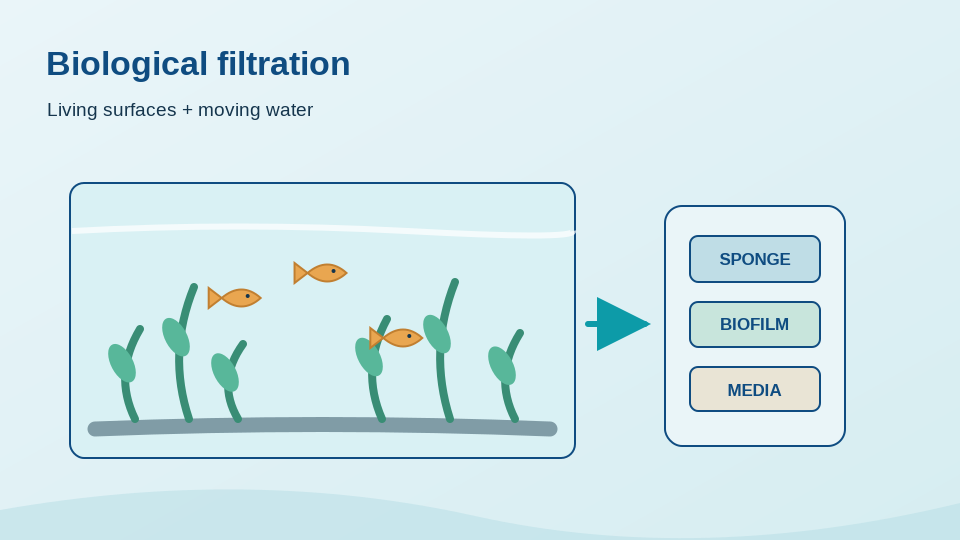
Key point: A biological filter is a living community on surfaces that aquarium water reaches. The filter housing helps by concentrating useful surface area and moving water through it; the housing alone does not make the tank cycled.
Surface colonization is why transferring only old aquarium water is a poor substitute for transferring appropriate mature media. Water may carry some organisms, but much of the useful community is attached. If you borrow media from another tank, use a healthy source and keep it wet and supplied with flow during the move.
Biological vs. Mechanical vs. Chemical Filtration

The three labels describe functions. Mechanical filtration catches particles such as food fragments and fine debris. Biological filtration gives microbes stable surfaces on which to process ammonia and nitrite. Chemical media targets selected dissolved substances through processes such as adsorption or ion exchange.
| Type | Main function | Common media | Ammonia role | Typical care |
|---|---|---|---|---|
| Mechanical | Captures suspended particles. | Sponge, floss, pads | Does not primarily process it. | Rinse or replace when clogged. |
| Biological | Supports nitrifying biofilms. | Sponge, ceramic rings, porous media, bio balls | Established microbes help oxidize it. | Preserve mature surfaces and flow. |
| Chemical | Targets selected dissolved compounds. | Carbon, specialized resins | Depends on the specific medium. | Follow medium-specific instructions. |
A sponge shows why the categories can overlap: it catches particles while its wetted surfaces support biofilm. Mechanical pre-filtration also helps biological media by keeping large debris from blocking water paths. Adding chemical media does not remove the need to establish and test the nitrogen cycle.
- Mechanical: catches debris.
- Biological: supports microbes.
- Chemical: targets selected dissolved compounds.
Where Does Biological Filtration Take Place?

A sponge filter, hang-on-back filter, canister, internal filter, sump, or suitable undergravel system can all host a biological community. Substrate and hardscape also offer colonizable surfaces, while live rock is important in many marine systems. The process is not limited to one branded medium or one compartment.
Filter chambers are especially useful because they combine surface area with repeated water contact. A running filter delivers oxygen and dissolved nitrogen waste to its media throughout the day. If water bypasses a packed basket, or debris blocks the flow, impressive advertised surface area may do little for the tank in practice.
A good biological filtration environment needs:
- Wet surfaces that microbes can colonize.
- Enough dissolved oxygen for aerobic nitrification.
- Reliable flow through and around the media.
- Conditions stable enough for the community to persist.
- Capacity appropriate to the actual feeding and livestock load.
More media can help only when it is used well. The useful question is whether enough water reaches active surfaces at a sustainable rate, not which package prints the largest pore-area number. A modest, maintained filter can outperform a larger unit left clogged.
Position the intake and return so water circulates through the aquarium rather than repeatedly moving through one small corner. Avoid overpacking a basket merely to fit more media; water needs open paths. If the filter's output falls noticeably, inspect the route from intake to outlet before assuming the motor is the only issue.
Common Types of Biological Filter Media

Biological media supplies durable habitat. It does not arrive with a mature community unless it has already been used in a healthy, established system and transferred appropriately. The best choice depends on filter design, water movement, ease of maintenance, and the aquarium's real waste load.
| Medium | Characteristics | Advantage | Consideration |
|---|---|---|---|
| Filter sponge | Reusable open foam | Combines particle capture and biofilm habitat. | Rinse when debris reduces flow. |
| Ceramic rings | Rigid porous pieces | Fits many baskets and chambers. | Can collect solids without pre-filtration. |
| Porous or sintered media | Complex internal and external surfaces | Compact media option. | Water paths must remain open. |
| Bio balls | Structured plastic pieces | Good exposure in suitable systems. | Effect depends on configuration. |
| Live rock | Natural marine structure | Habitat throughout a marine tank. | Relevant mainly to saltwater systems. |
| Substrate | Large wetted area in the tank | Supplemental habitat. | Not a universal replacement for filtration. |
Price alone does not indicate biological performance. A reusable sponge with dependable flow can be valuable, and an expensive porous product can disappoint when it is packed into a chamber that clogs. Choose a material that suits the equipment and can be maintained without destroying the biofilm.
Media shapes are practical choices as much as microbiological ones. Rigid pieces may be easy to lift out of a basket, while foam is simple to squeeze gently when it fills with solids. Whatever the material, assess whether it remains intact, allows water through, and can stay in service long enough to mature.
How to Establish Biological Filtration in a New Aquarium

A new filter starts as equipment, not as a mature biological filter. The colonizing community needs time, oxygenated flow, and a controlled nitrogen source. A responsible cycling method lets you observe the system before asking it to process a full livestock load.
- Install the filter and the media you intend to keep.
- Prepare water so chlorine or chloramine will not reach the biofilter untreated.
- Run circulation and aeration consistently.
- Provide an appropriate ammonia source under a chosen cycling protocol.
- Measure ammonia and nitrite with suitable tests.
- Allow the microbial community to develop while monitoring results.
- Confirm the expected load can be processed before stocking heavily.
- Add animals gradually and keep checking after changes.
Established media from a healthy tank can help seed a new setup, but moving it also carries disease or pest risks between aquariums. Bottled products may be used according to their directions. Neither shortcut replaces testing the receiving tank under its own conditions.
During a fishless cycle, follow a responsible method for adding the nitrogen source and avoid overdosing simply to force faster growth. A fish-in cycle requires particularly careful testing and actions suited to the animals already present. The goal in either case is a stable process that matches the planned load, not a dramatic color change on one test day.
How Long Does Biological Filtration Take to Mature?

There is no universal number of days. Temperature, pH, oxygen, inoculation, ammonia availability, and filter layout can change the pace. A calendar tells you how long the tank has been running; repeated water tests tell you more about what it can actually process.
Before calling a new tank biologically ready:
- The filter runs continuously with permanent media installed.
- Circulation and oxygenation suit the system.
- Ammonia and nitrite are being processed under the chosen protocol.
- Results remain stable rather than showing an unexplained rise.
- Stocking can increase gradually, with follow-up checks.
How to Maintain Biological Filtration Without Crashing the Cycle

Mature bio media does not need to look new. A brown coating can be part of a functioning surface, although trapped debris should not be allowed to choke flow. Clean to restore water movement, not to sterilize everything in the filter.
| Do | Avoid |
|---|---|
| Keep the filter running and preserve mature media. | Replace every colonized piece at one time. |
| Gently loosen excess debris in removed tank water or suitable dechlorinated water. | Scrub or sterilize all biological surfaces during routine care. |
| Maintain mechanical pre-filtration so flow stays open. | Leave heavily loaded media clogged for long periods. |
| Test ammonia and nitrite after major maintenance. | Assume moving water proves the biofilter was unaffected. |
| Stagger disruptive work when possible. | Combine total media replacement with sudden heavy stocking. |
If a filter must be stopped for service, work efficiently and keep established media wet. After a prolonged power loss, treat the filter and tank as a system that may have changed; restore safe flow and test rather than assuming yesterday's capacity survived unchanged.
It is often sensible to clean a clogged mechanical pad without dismantling every biological basket. If the whole unit needs attention, work in stages when the design allows it. Keep track of what was serviced so an unexpected ammonia reading afterward can be interpreted against a clear maintenance record.
Should Biological Filter Media Be Replaced?

Reusable sponge and rigid media can remain useful for a long time when structurally sound and open to water flow. Replace material because it is crumbling, damaged, or impossible to maintain adequately, not because a fixed month has arrived. When a change is necessary, replacing only part at a time can preserve more established habitat.
What Can Disrupt Biological Filtration?

A filter may still pump water after its biological capacity falls. The motor and the microbes are different parts of the system. Check for a recent event before assuming that a water-quality change has no connection to filtration.
- Untreated chlorine or chloramine: disinfectants can harm established biofilm.
- Replacing mature media: removing too much at once removes colonized surface.
- Over-cleaning: aggressive scrubbing can strip the community the filter depends on.
- Stopped flow or low oxygen: aerobic nitrification needs oxygenated water contact.
- Severe clogging: debris can restrict delivery to active surfaces.
- Sudden higher bioload: more fish or feeding can outpace current capacity.
- Certain treatments: some medications may affect biofilter organisms; follow product guidance.
- Environmental instability: abrupt changes can alter microbial activity.
These are possibilities, not a diagnosis from one symptom. After a disruptive event, measure ammonia and nitrite and review what changed. Address an unsafe reading using methods appropriate to the species and the tank, and continue testing while the system stabilizes.
A treatment label may warn that a product affects the biological filter; read it before dosing and monitor the tank afterward. Likewise, a filter left full of waste during a long outage deserves closer inspection before being restarted. The key is to combine safe equipment handling with water tests rather than assuming the biofilm is either intact or completely lost.
Signs Your Biological Filter May Be Struggling

Testing is more informative than trying to read the water's color. Fish at the surface or unusual behavior deserve attention, but those signs alone cannot tell you whether ammonia, nitrite, low oxygen, disease, or another stressor is involved.
| Observation | Possible explanation | What to check |
|---|---|---|
| Ammonia detected | Biological capacity may be inadequate or disrupted. | Stocking, feeding, maintenance, water treatment, cycling. |
| Nitrite detected | Nitrification may be incomplete or disturbed. | Repeat tests and review recent changes. |
| Spike after new fish | Waste input rose faster than capacity. | Feeding, test trends, and animal stress. |
| Spike after media change | Established biofilm may have been removed. | Remaining mature media and test trends. |
| Reduced filter flow | Mechanical media or passages may be clogged. | Intake, pads, impeller, and water route. |
| After power outage | Loss of circulation and oxygen may matter. | Flow restoration, ammonia, and nitrite. |
Record dates and readings instead of relying on one strip or one glance. Compare tests made with the same method, follow the kit instructions, and seek experienced aquatic-veterinary help if animals are in acute distress. An apparently clear tank can still need prompt action.
When a result seems surprising, repeat it carefully and check the test's expiry date and units. A trend across several measurements is usually more informative than a single isolated number. Record feeding, new livestock, medication, cleaning, and power interruptions beside the readings; those notes can reveal a change in demand or filter conditions.
Does Biological Filtration Work Differently in Freshwater and Saltwater Aquariums?

The basic need to process nitrogen waste exists in both freshwater and marine tanks. The surfaces and broader nutrient-management plans can differ, so the same media label does not imply an identical complete system.
| Aquarium | Biological surfaces | Additional consideration |
|---|---|---|
| Freshwater | Sponge, ceramic media, substrate, plants, and hardscape. | Match filter flow and maintenance to the waste load. |
| Planted | Filter media plus plant and hardscape surfaces. | Plants may use nitrogen, but testing and circulation still matter. |
| Saltwater | Live rock, sand, sump, and filter media. | Marine systems may use additional export methods. |
Healthy plant growth can help nutrient management, but beginners should not assume plants erase a nitrite spike or replace every biological function. Likewise, live rock is a valuable marine habitat, yet its presence does not make circulation, testing, and appropriate export optional.
Do not transfer a mature freshwater filter to seawater and assume it will retain the same performance. Salinity and other conditions select different communities, and an abrupt move can change biological activity. Plan a marine setup and its cycling around its own water conditions, then verify the result with appropriate tests.