How the system works
What Is an Aquarium Air Pump?
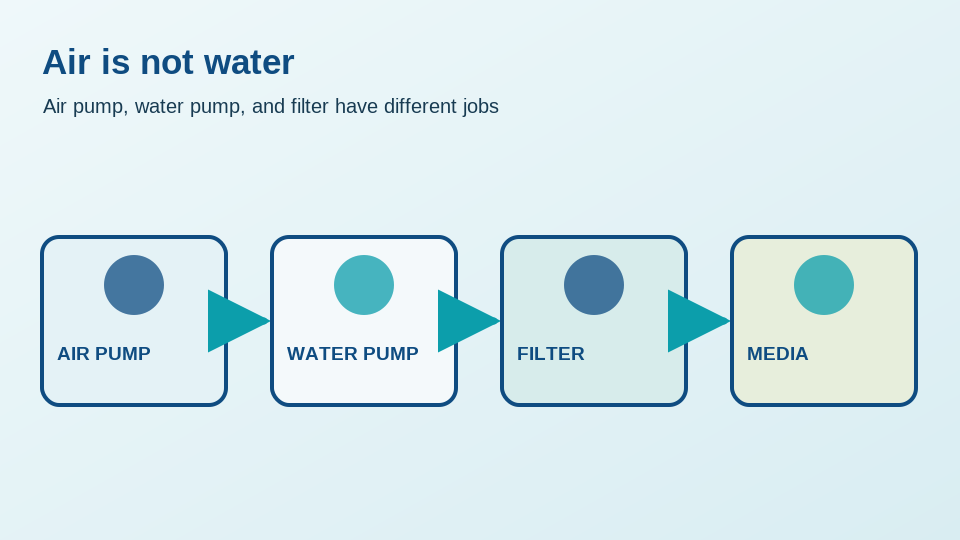
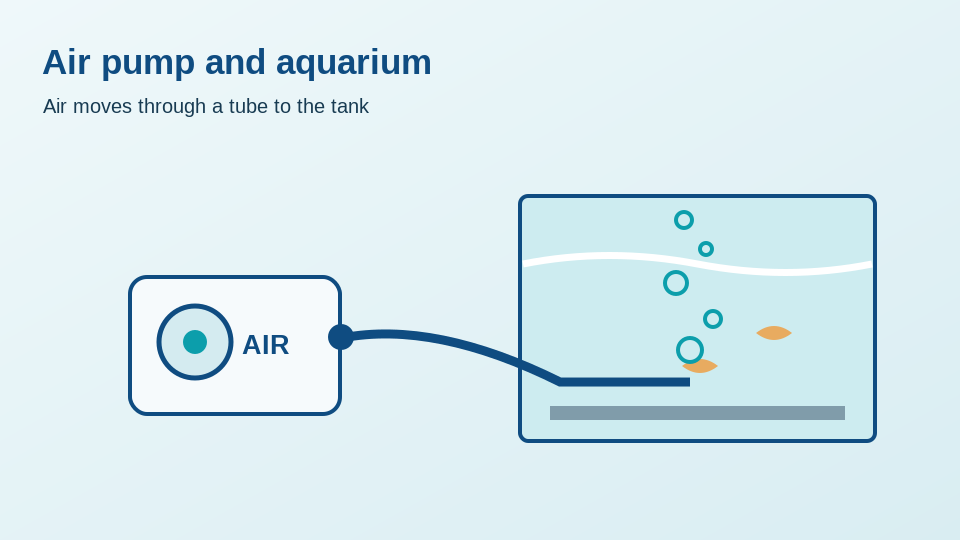
An aquarium air pump is an electrical device designed to move air into aquarium equipment. It normally stays dry and outside the tank. Its outlet accepts narrow flexible tubing, which carries air to a submerged accessory. The pump's job is to maintain airflow against the resistance created by tubing, water depth, and the connected device.
It helps to distinguish three pieces of equipment that can look similar in a product listing:
| Equipment | What it moves | Primary job |
|---|---|---|
| Air pump | Air | Powers air-driven devices and promotes aeration. |
| Water pump | Water | Circulates or transfers aquarium water. |
| Aquarium filter | Water through media | Captures debris and supports water-quality processes. |
The functions can overlap as a system. For example, an air pump sends bubbles up a sponge filter's lift tube. The rising air moves water through the sponge, which catches particles and gives microbes a surface to colonize. The air pump supplies energy for that process, while the sponge is the filter medium.
A bare airline ending in the tank creates bubbles but is not a complete filter. Likewise, a circulation pump can move the surface without injecting air. Choose a device according to the work the aquarium needs, rather than treating every pump or filter as interchangeable.
If a listing calls a product an “oxygen pump,” check what it actually supplies. Most household units draw ordinary room air; they do not make pure oxygen. Their value comes from moving that air to a device and increasing the contact between aquarium water and the surrounding atmosphere.
How Does an Aquarium Air Pump Work?

Most small home aquarium air pumps use a rapidly moving flexible diaphragm. A motor or electromagnetic mechanism flexes that diaphragm back and forth, changing the pressure in a small chamber. Internal one-way valves guide air from an intake toward the outlet so each cycle adds to the outward flow.
- The pump draws room air into its housing.
- A motor or electromagnetic mechanism moves a diaphragm.
- Diaphragm movement creates repeated pressure changes.
- Internal one-way valves direct airflow.
- Air exits the pump outlet under pressure.
- Airline tubing carries it toward the aquarium.
- An air stone, sponge filter, or diffuser releases it underwater.
- Rising bubbles pull surrounding water upward.
- Surface movement helps gas exchange.
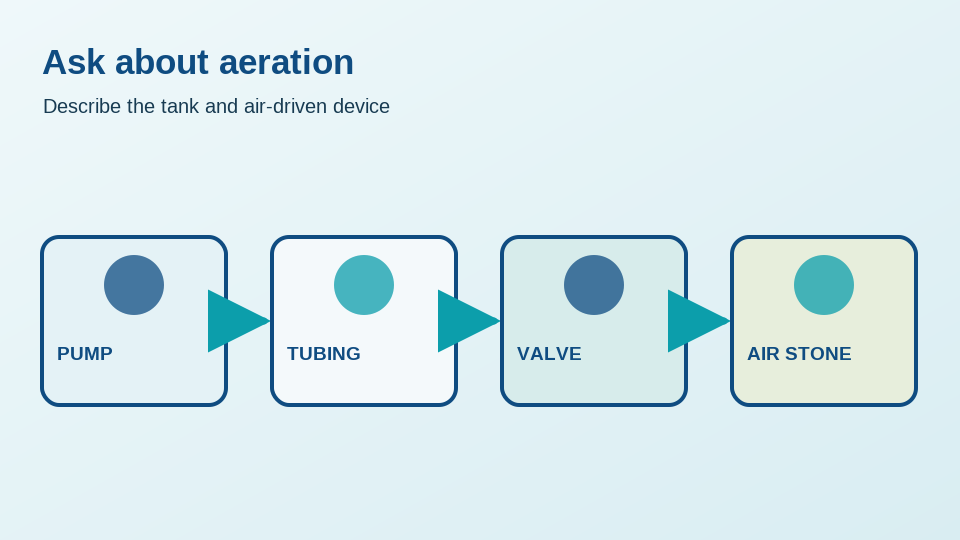
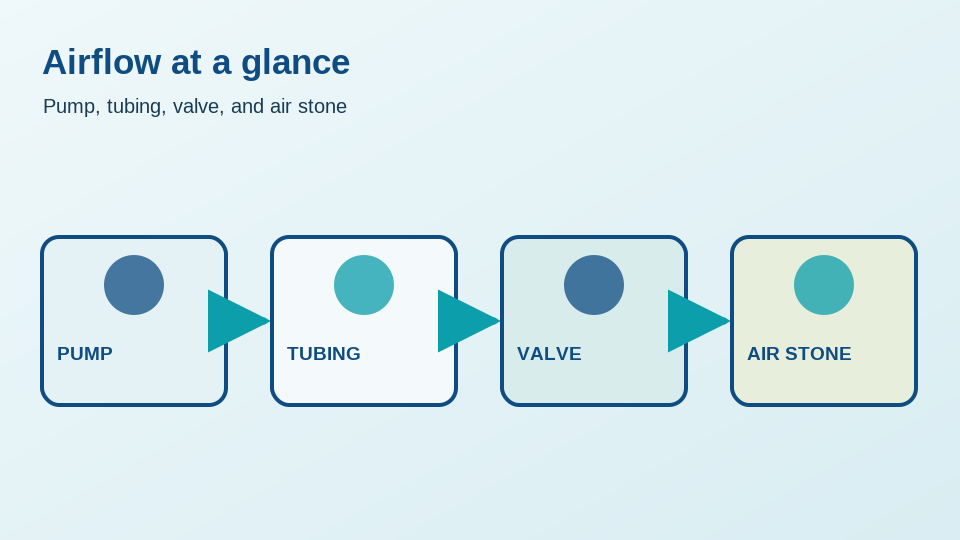
Airflow path: Room air → pump → airline tubing → check valve → air-driven device → bubbles → surface agitation.
The check valve in that path is an external safety accessory, distinct from the small valves inside the pump. It allows air to travel toward the tank while helping block water from traveling backward if conditions permit a siphon. Follow the valve's own directional marking when installing it.
Tank depth matters because the pump must push air against the pressure of the water above the outlet. A deep air stone, several sponge filters, a long tube, or a restrictive diffuser can reduce delivered flow. Larger multi-tank systems may use other pump designs, but the useful household principle is the same: air must reach each device at a suitable rate.
When the pump is switched on, bubbles may take a moment to appear as the line fills and pressure builds. If the outlet remains dry after that, trace the whole path before assuming the pump motor has failed. A reversed valve or pinched tube can stop a working diaphragm from delivering visible bubbles.
Diaphragms and internal valves are moving parts, so their performance can change with age. A gradually weaker stream may be caused by wear, but first remove simpler restrictions in the tubing and diffuser. Service or replace pump components only as the specific manufacturer's instructions allow.
Do Bubbles Add Oxygen to the Water?

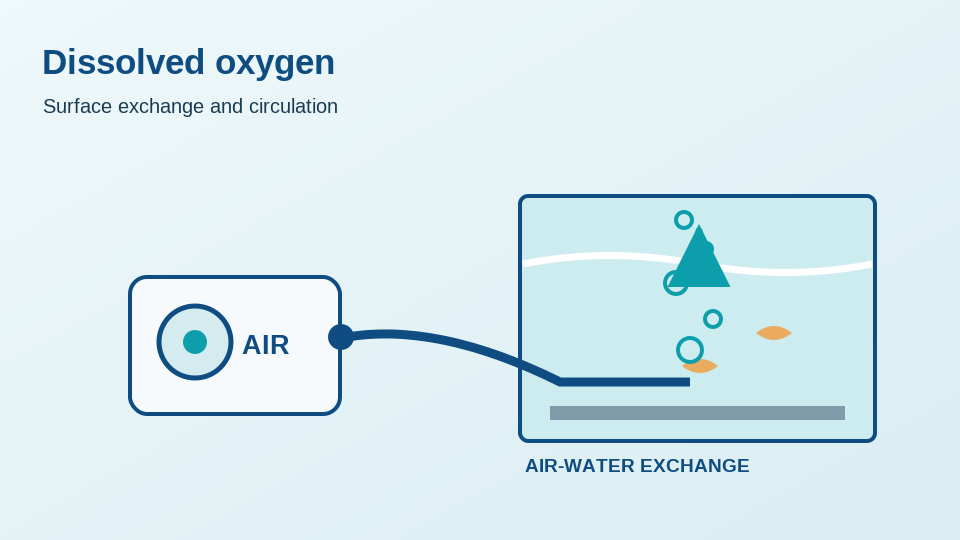
Yes, an air pump can help increase oxygen availability, but the main practical mechanism is surface agitation and gas exchange. Some oxygen can dissolve directly from bubbles. The larger effect in many aquariums is that a rising bubble column lifts water to the top and keeps the surface moving.
Dissolved oxygen is oxygen already mixed into the water and available to aquatic life. At the air–water boundary, oxygen can enter water while carbon dioxide can leave. Fish, invertebrates, and aerobic microorganisms use dissolved oxygen. A still surface may exchange gases less effectively than a gently moving one, especially when water below it is poorly circulated.
| Surface condition | Gas exchange |
|---|---|
| Very still | Movement and renewal at the boundary may be limited. |
| Gently moving | Regular renewal generally improves exchange. |
| Strong, controlled agitation | Greater exchange potential, if the flow suits the tank. |
More turbulence is not automatically better. Excessive bubbling can disturb fish that prefer calm water, splash the rim, or disrupt a carefully planned flow pattern. Observe the entire tank: surface ripples, circulation below, fish behavior, temperature, and any relevant test readings provide a fuller picture than the number of bubbles alone.
Warm water generally holds less dissolved oxygen than cool water. During a warm period, increasing appropriate surface movement may be useful, but the pump should be one part of a broader check of temperature, stocking, filtration, and maintenance. Visible bubbles do not prove that every area of the tank has adequate oxygen.
A dense patch of floating plants, a tight lid, or a return aimed below the surface can change how water and air meet. Look for gentle renewal across the usable surface rather than one dramatic bubble column in a corner. If you measure dissolved oxygen, interpret the reading alongside time of day and temperature.
Main Parts of an Air Pump Setup

Most systems need a pump, tubing, and a compatible air-driven device. Other accessories help with safety or control, but adding every available fitting can make the path harder to inspect and may increase resistance.
| Component | Purpose |
|---|---|
| Air pump | Generates airflow. |
| Airline tubing | Carries air to the tank. |
| Air stone or diffuser | Breaks flow into smaller bubbles. |
| Check valve | Helps prevent water siphoning backward. |
| Airflow control valve | Adjusts delivered flow. |
| T-connector | Splits a line into multiple paths. |
| Gang valve | Distributes and controls several lines. |
| Sponge filter | Uses rising air to pull water through sponge media. |
An air stone is optional when the pump feeds a sponge filter or another compatible air-driven device directly. Not every tank needs a T-connector or gang valve either. If you add branches, remember that each device shares the pump's available output; an attractive arrangement on paper may leave the deepest or most restrictive outlet weak.
Air stones can clog with use, increasing resistance. Tubing can kink, harden, or leak at a loose connection. A check valve also has a correct airflow direction. Labeling or photographing a working setup before maintenance can make reassembly easier without guessing which fitting went where.
Choose tubing that fits the pump and accessory ports firmly. Avoid stretching a line across a sharp edge or placing it where furniture will pinch it. These small installation choices affect performance more than an extra decorative fitting.
When using a gang valve, set each branch while all intended devices are connected. Air tends to favor an easier outlet, so one open line can leave another weak. Adjusting one branch may change the others; recheck every stone or sponge filter after making a change.
Does Every Aquarium Need an Air Pump?

No. A separate air pump is not a standard requirement for every aquarium. The useful questions are whether the tank already has enough surface movement and circulation, whether dissolved oxygen is adequate for its inhabitants, and whether any device specifically requires an air supply.
| Situation | Air pump? | Reason |
|---|---|---|
| Sponge filter is the main filter | Required | Water movement depends on airflow. |
| Air stone or bubbler installed | Required | The accessory needs an air source. |
| Filter already moves the surface | Possibly optional | Gas exchange may already be adequate. |
| Warm, heavily stocked tank | Often useful | Oxygen demand may be higher. |
| Quarantine tank | Often useful | Simple additional aeration is practical. |
| Transport or outage planning | Useful with battery power | Can maintain aeration away from mains power. |
Stocking level alone is not a complete rule. Water temperature, surface area, filter return position, circulation, plant activity, and equipment all influence oxygen conditions. If the existing filter creates steady surface ripples and the tank is otherwise well managed, another pump may add little practical benefit.
Conversely, a sponge filter cannot function by merely being submerged; it needs ongoing airflow. If you plan to rely on it for biological filtration, consider how that flow will continue during routine use and what backup options are available for power failures.
For a planted tank, surface movement should still be judged in context. The goal is a stable environment for livestock and the equipment being used, not a rule that every planted aquarium must be still or every fish tank must bubble. Observe the system across normal day and night operation.
Benefits and Limits of Air Pumps

Main benefits
- Moves the water surface and supports gas exchange.
- Circulates some water vertically from the bubble column.
- Powers sponge filters and other air-driven devices.
- Can offer gentle movement where a strong water pump would be unsuitable.
- May help provide extra aeration during warm conditions.
- Battery-powered models can be useful for emergency aeration.
- An adequately sized pump can serve several simple devices.
That mix of uses makes an air pump versatile. A small unit can run one air stone, while a correctly sized multi-outlet system can support several devices. The benefits depend on sufficient delivered airflow at the intended depth, not just a printed maximum output under ideal conditions.
What an air pump does not do
- It does not automatically replace a complete filtration system.
- It does not remove debris or chemically eliminate ammonia, nitrite, or nitrate by itself.
- Bubbles do not prove that oxygen conditions are perfect everywhere.
- It cannot solve chronic overstocking or poor maintenance.
- A standard mains-powered model stops during an outage unless backup power is available.
- Maximum airflow is not always the most suitable setting.
Air pump vs. air stone: the pump creates and delivers airflow. An air stone is a porous end piece that disperses that flow into bubbles. They are separate components, so replacing a blocked stone does not require replacing a healthy pump.
A pump can be a helpful part of a stable aquarium, but it does not make water-quality testing unnecessary. If fish behavior changes, inspect filtration, temperature, and water chemistry along with aeration.
How to Choose the Right Air Pump

A tank-size rating is a starting point, not a universal airflow formula. Check the pump maker's guidance for pressure, depth, output, and the types of devices it can support. A tall narrow tank can ask for more pressure than a shallow tank with a similar water volume.
| Factor | Why it matters | What to check |
|---|---|---|
| Aquarium size | Larger systems may need more air. | Manufacturer tank-size guidance. |
| Tank depth | Depth increases back pressure. | Recommended depth or pressure. |
| Number of devices | Several outlets share output. | Outlet count and delivered flow. |
| Air stone resistance | Fine or clogged pores restrict air. | Diffuser compatibility and condition. |
| Tubing length | Long runs can reduce output. | Keep the run practical and open. |
| Adjustable airflow | Limits unwanted turbulence. | Pump control or compatible valve. |
| Noise | Moving parts can vibrate. | Mounting and noise-control design. |
| Power backup | Matters during an outage. | Battery or backup compatibility. |
One small stone near the surface is a different workload from multiple sponge filters at the bottom of deep tanks. A T-connector does not create extra air; it divides what the pump already provides. If several outlets are planned, ask whether they can all receive useful flow at the same time.
Noise specifications can be difficult to compare across rooms and mounting surfaces. A stable shelf with a soft vibration-isolating base may matter as much as the advertised noise level. Choose equipment that can be serviced and whose replacement diaphragm or other consumable parts are available if the manufacturer provides them.
For a tank that depends on air-powered filtration, think about reliability and power continuity before choosing the smallest pump that barely produces bubbles. Follow the manufacturer's sizing guidance rather than inventing a fixed number of liters per minute for each gallon.
Keep room for practical maintenance as well. A pump hidden behind a heavy cabinet may be difficult to inspect when output drops. If several aquariums share one air source, mark the tubing branches so you can identify an affected tank quickly and avoid accidentally adjusting the wrong valve.
How to Set Up an Air Pump Safely

Install the air pump outside the aquarium in a dry, stable location. Ordinary external units are not submersible. Read the pump and accessory instructions, particularly if the installation is below the aquarium water level.
- Choose a safe, stable pump position outside the tank.
- Measure a practical tubing run and connect it firmly.
- Attach the air stone, sponge filter, or other aquarium-side device.
- Add a check valve where back-siphoning is a concern, especially below the waterline.
- Follow the valve's marked direction for airflow toward the tank.
- Make a drip loop in the electrical cord below the outlet.
- Keep the plug and connections dry, then connect power.
- Confirm steady air at the device and adjust flow if needed.
A drip loop lets water traveling along the outside of a cord fall away before it reaches the electrical outlet. The check valve addresses a different risk: water moving backward inside airline tubing. Neither measure substitutes for careful positioning and the instructions supplied with the actual equipment.
Safety checklist
- Keep plugs and connections dry.
- Do not submerge a standard external pump.
- Check the valve's arrow or marking, not its appearance alone.
- Inspect tubing for cracks, hardening, kinks, or loose ends.
- Use manufacturer guidance for installation and servicing.
After setup, watch the line for a few minutes. A pump that sounds normal but produces weak bubbles may be facing a blocked stone, excess depth, or a wrong-way valve. Fix the airflow path before leaving an essential sponge filter unattended.
Check the arrangement again after moving the aquarium or cleaning around the stand. Tubing can be pulled loose, a valve can be reversed during reassembly, and the cord's drip loop can disappear when the plug is moved. A quick visual check is easier than diagnosing a silent filter later.
Running and Troubleshooting an Air Pump

Should an Aquarium Air Pump Run 24/7?
If the pump powers the main sponge filter or supplies aeration the aquarium relies on, continuous operation is generally appropriate. Do not routinely switch off essential air-driven filtration overnight simply to remove its sound. A tank with another filter and adequate surface movement may have different needs; judge the whole system.
In a power outage, a normal mains-powered pump stops. A battery-operated model or suitable backup power can support an emergency plan, but it must be tested and maintained. Plan for the actual devices that need air rather than assuming any backup pump can run an entire multi-tank manifold.
Common problems and fixes
| Problem | Possible cause | What to check |
|---|---|---|
| No bubbles | Disconnected tube, reversed valve, failed pump. | Connections and valve direction. |
| Weak bubbles | Clogged stone or restricted tubing. | Clean or replace affected parts. |
| Excessive bubbles | Airflow too high. | Reduce adjustable output appropriately. |
| Loud vibration | Resonant shelf or adjacent object. | Stabilize and isolate the pump. |
| Noise increases over time | Wear or rising back pressure. | Inspect diaphragm and connected devices. |
| Uneven output | Split flow or a restriction. | Valves, tubing, and each outlet. |
When diagnosing weak output, disconnect or inspect one component at a time, following the manufacturer's safe-service instructions. An old clogged air stone can make a healthy pump appear underpowered. Conversely, a worn diaphragm may fail to maintain flow even after the line is clear.
Set the pump on a stable surface away from hard objects that amplify its vibration. Avoid sealing it inside an airtight box to hide noise; it needs access to room air and must be used as instructed. If troubleshooting affects essential filtration, watch the tank closely and restore adequate circulation promptly.
If only one of several outlets weakens, compare that branch with the others. A local kink, worn connector, or plugged diffuser is more likely than an equally distributed pump failure. If every outlet declines together, inspect the shared intake, pump, and common tubing before replacing several working accessories.