
Aquarium water guide
What Is Dissolved Oxygen in Aquarium Water?
Dissolved oxygen (DO) is free molecular oxygen, O₂, dissolved in aquarium water. Fish draw it across their gills; invertebrates and aerobic microorganisms need it too. It is separate from the oxygen atom bound in every H₂O molecule. A tank gains oxygen mainly where water meets air, while breathing, biological filtration, and decaying waste use it. The amount available changes with temperature, salinity, circulation, and demand. This guide explains what a reading means, when low oxygen is plausible, and how to improve oxygenation without assuming bubbles or fish behavior tell the whole story.

At a glance
Quick Reference
| Question | Quick answer |
|---|---|
| What is DO? | O₂ dissolved in water and available for respiration |
| How is it measured? | mg/L, ppm, or percent saturation |
| Useful freshwater reference? | About 7–8 mg/L is well oxygenated for many community tanks; needs vary |
| When is low DO concerning? | About 5 mg/L and below can stress many fish |
| What reduces capacity? | Heat, salinity, and lower atmospheric pressure |
| What helps most? | Surface agitation, circulation, and gas exchange |
| Do more bubbles prove more DO? | No. Water movement and surface exchange matter more |
These are general references, not species-specific care thresholds.
Overview
The Aquarium Oxygen Cycle
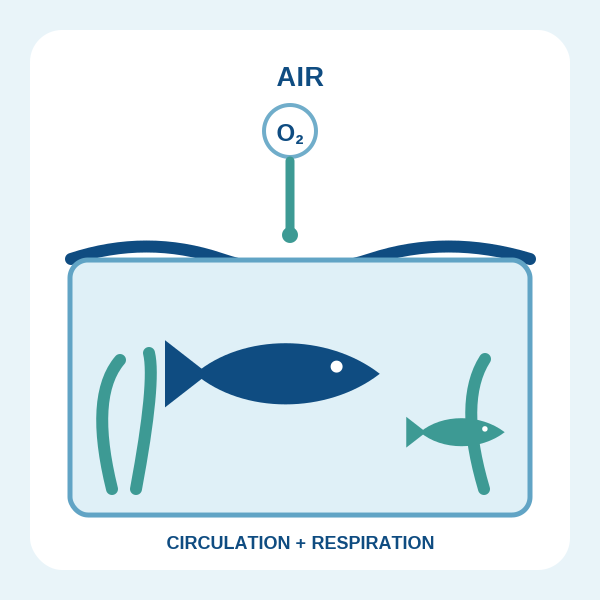
Air surrounds the tank, but fish cannot breathe that air unless oxygen gas enters the water. At the water–air interface, oxygen moves into water when the water holds less than it could under the current conditions. A rippling surface continually brings new water to that interface. Circulation then distributes dissolved oxygen to fish, shrimp, filter media, and quieter parts of the aquarium.
Demand never stops. Animals and aerobic microbes consume oxygen; decomposers use more as they break down food, leaves, and waste. Plants add oxygen during photosynthesis in sufficient light, but they respire throughout the day and night. Thus one afternoon reading may not describe the overnight minimum. Visible bubbles show movement, not a measured oxygen concentration.
The three ideas to remember
- Oxygen enters mainly through gas exchange at the surface.
- Biological demand changes with livestock, plants, waste, and time of day.
- Warm or poorly circulated water leaves less safety margin.
What Exactly Is Dissolved Oxygen?

Think of oxygen gas molecules dispersed among water molecules. Gills transfer that dissolved O₂ into a fish's bloodstream. The oxygen atom inside H₂O is chemically bound; a fish cannot extract it through ordinary breathing. This distinction explains why a full tank can still be oxygen deficient. Clear-looking water says little about the amount of free O₂ present.
A dissolved oxygen meter usually reports milligrams of O₂ per liter (mg/L). In dilute freshwater, aquarists often use parts per million (ppm) as a practical near-equivalent. Percent saturation asks a different question: how close is the water to the oxygen concentration expected at equilibrium for its temperature, pressure, and salinity? A reading of 8 mg/L can therefore represent different saturation percentages in a cool freshwater tank and a warmer or salty one.
| Term | Meaning | Why it helps |
|---|---|---|
| mg/L | Milligrams of O₂ per liter | Direct concentration |
| ppm | Parts per million | Common hobby shorthand, close to mg/L in freshwater |
| % saturation | Measured DO relative to equilibrium capacity | Adds context for temperature, salinity, and pressure |
Why Oxygen Matters in an Aquarium

Fish use oxygen to support respiration, swimming, feeding, and recovery from stress. Shrimp, snails, and other aerobic animals also need it. A tank can look calm while demand climbs inside a crowded aquarium or a dirty filter. Oxygen is part of the whole system's stability, not merely a number for fish.
Biological filtration has an oxygen cost. Nitrifying microorganisms convert ammonia to nitrite and then nitrate using oxygen. If circulation or oxygen supply fails, that process can be impaired while fish are also under stress. The U.S. EPA describes this connection between nitrification and dissolved oxygen. DO does not replace ammonia, nitrite, nitrate, pH, or temperature testing; those measurements answer different questions.
Who uses oxygen in your aquarium?
- Fish: gill respiration and normal activity.
- Invertebrates: respiration, including in low-flow spaces.
- Filter microbes: aerobic processing of nitrogen waste.
- Plants: continuous respiration, even when photosynthesis adds oxygen.
- Decomposers: breakdown of food, plant debris, and waste.
What Is a Good Dissolved Oxygen Level?
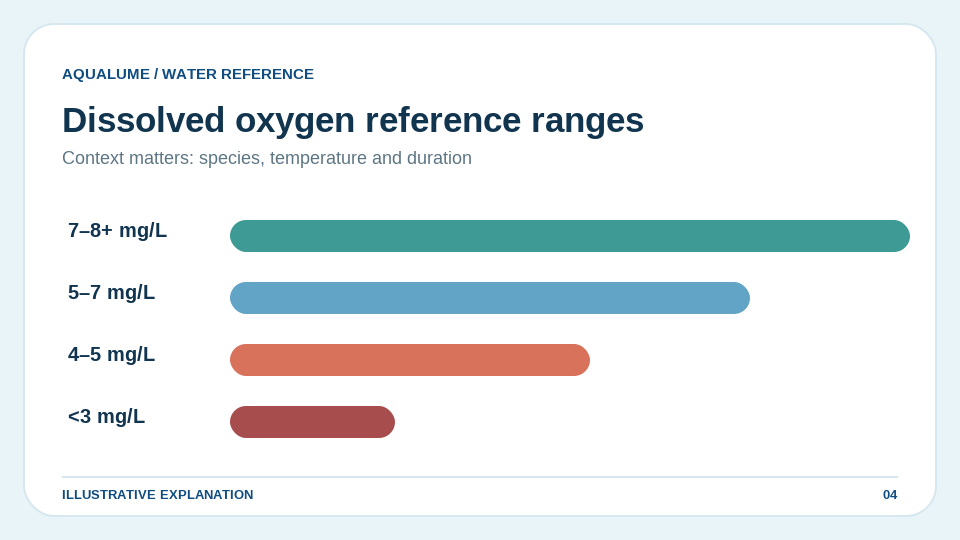
There is no single perfect number for every fish tank. As a broad freshwater community-tank reference, about 7–8 mg/L describes well-oxygenated water for many setups. Around 5 mg/L and below can be stressful for many fish; around 4 mg/L or lower warrants prompt investigation and action; around 3 mg/L or lower may be dangerous. These are overlapping warning bands, not sharp biological switches or guaranteed safety limits.
| Measured DO | General interpretation for many freshwater tanks |
|---|---|
| 7–8+ mg/L | Often well oxygenated, with species needs still taking priority |
| 5–7 mg/L | May be adequate for many fish; safety margin varies |
| 4–5 mg/L | Caution: check livestock, temperature, flow, and demand |
| 3–4 mg/L | Low for many fish; corrective action is appropriate |
| Below 3 mg/L | Potentially dangerous for many fish |
Species, life stage, activity, stocking, exposure duration, water temperature, and salinity all change how a result should be read. Cold-water or active species may need a larger oxygen margin than some warm-water or low-flow-adapted fish. A sensitive animal can show trouble before a general table suggests it. Compare readings with fish behavior and the tank's usual pattern; consult species-specific husbandry guidance when choosing a target. The EPA's aquatic-life overview also emphasizes differing tolerances.
Temperature, Salinity, and Altitude
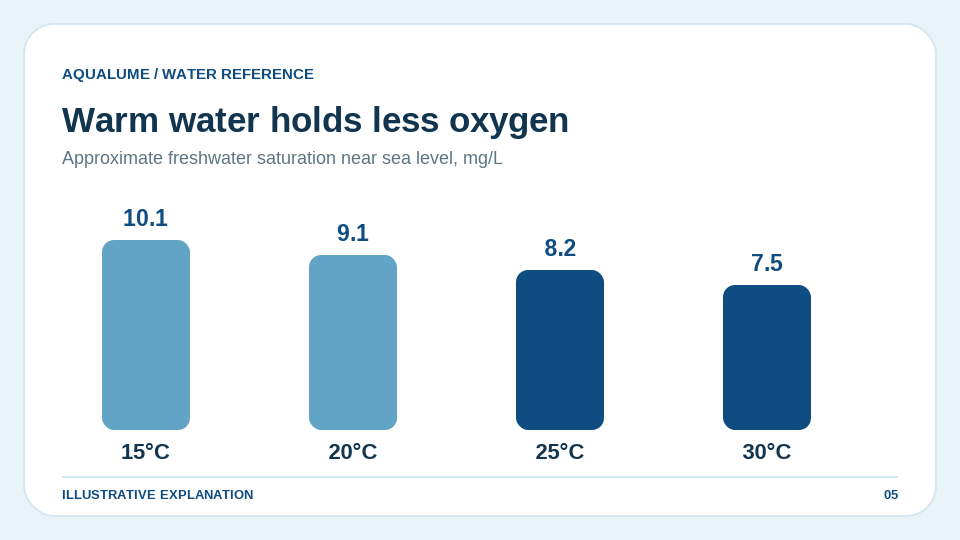
Warmer water holds less oxygen at equilibrium. At the same time, warmth can raise the metabolic demand of fish and microorganisms. This double pressure explains why heat waves, crowded tanks, and weak water movement are a troublesome combination. The values below are approximate 100% saturation capacities for freshwater near sea-level pressure, not recommended aquarium targets.
| Water temperature | Approximate saturation |
|---|---|
| 15°C / 59°F | 10.1 mg/L |
| 20°C / 68°F | 9.1 mg/L |
| 25°C / 77°F | 8.2 mg/L |
| 30°C / 86°F | 7.5 mg/L |
Salt also reduces oxygen solubility. Around 25°C, oxygen-saturated seawater can hold roughly one-fifth less O₂ than comparable freshwater under the same pressure. At higher elevation, lower atmospheric pressure reduces the equilibrium concentration as well. An 8 mg/L reading is therefore not equivalent in every tank, and percent saturation can help interpret the difference. The EPA temperature table and USGS solubility tool provide the underlying context.
Factors that reduce the oxygen safety margin
- Higher water temperature, especially with rising biological demand.
- Higher salinity at the same temperature and pressure.
- Lower atmospheric pressure, as at higher altitude.
What Causes Low Oxygen?

Low DO results when oxygen enters too slowly, is distributed poorly, or is consumed faster than it is replenished. Several causes can occur together. A stopped filter removes circulation while its media and the rest of the tank still consume oxygen. A bloom of bacteria or decay after overfeeding can add demand quickly. Healthy plants are useful during lighted photosynthesis, yet a dense planted tank also respires overnight.
| Risk factor | Why it matters |
|---|---|
| High temperature | Lower oxygen capacity; often higher demand |
| Flat surface or biofilm | Less effective water–air exchange |
| Weak flow or dead zones | Uneven distribution of oxygenated water |
| Heavy stocking or feeding | More respiration and organic waste |
| Dead livestock, leaf decay, algae die-off | Microbial decomposition consumes oxygen |
| Bacterial bloom or treatment | May increase oxygen demand or alter conditions |
| Power outage or blocked filter | Stops circulation and surface movement |
| Dense floating plants | Can limit open surface and reduce light below |
| Heavily planted night period | Respiration continues without photosynthesis |
Look for the cause rather than blaming one object, such as plants or air pumps. Check what changed recently: a hot afternoon, a blocked outlet, a dead fish, a medication, or an unusually large feeding. The USGS explanation of DO links heat, stagnant water, and decomposing organic material with oxygen depletion.
Signs of Low Oxygen in Fish

Changes in behavior can be the first clue, especially when several fish are affected at once. Early signs include reduced activity or appetite, faster gill movement, unusual positions in the tank, or fish clustering by a filter outlet where flow is stronger. More serious signs include repeated surface gasping, persistent rapid respiration, crowding at the top, loss of coordination, and marked lethargy.
Surface gasping is an important warning sign, but it is not a dissolved-oxygen test. Ammonia, nitrite, excessive CO₂, gill disease or injury, heat, and other water-quality problems can look similar. Observe the whole tank and compare with actual measurements whenever possible. A fish that normally breathes air at the surface also needs species-aware interpretation.
If several fish suddenly start gasping
- Increase safe surface movement and restore filter or pump flow.
- Check temperature and test ammonia and nitrite.
- Measure DO if a suitable meter or kit is available.
- Check recent feeding, treatments, decaying material, and CO₂ delivery.
- If distress persists, seek experienced aquatic veterinary or husbandry help.
How to Measure Dissolved Oxygen

A digital DO meter gives a direct reading and is convenient for repeat checks. Meters may use optical or electrochemical probes; either type must be used and maintained as its maker specifies. Chemical oxygen tests are another option, though less common in home aquariums. The Winkler titration is a classic laboratory method and useful context, not a routine chore every aquarist must perform.
Calibration matters more than buying the most elaborate instrument. Follow the instructions for temperature and salinity compensation; consider local atmospheric pressure or elevation when interpreting percent saturation. Keep the probe clean and allow the reading to stabilize. A single number gains meaning when recorded with time, temperature, recent changes, fish behavior, and where in the tank it was measured. The YSI measurement guide explains sensor methods and saturation.
When should you test?
- When fish repeatedly gather at the surface or breathe unusually fast.
- During heat waves or after a pump, filter, or power failure.
- In heavily stocked tanks or after a suspected bacterial bloom.
- Before and after major changes to aeration or circulation.
- In planted tanks shortly before lights turn on, when DO may be lowest.
How to Increase Aquarium Oxygen

Start with the mechanism: improve contact between water and air, then circulate that oxygenated water through the aquarium. Adjust a suitable filter outlet to make gentle but visible ripples. A spray bar, sponge filter, air stone, or circulation pump can help when it moves water and disturbs the surface. The count of bubbles is less important than the exchange and circulation they create.
Keep some of the surface open; remove heavy film and prevent floating plants from sealing most of it. In larger tanks, check for weak-flow corners rather than making one end turbulent. If temperature is above the livestock's appropriate range, bring it down gradually and safely while preserving stable conditions. Reducing overfeeding, decaying material, and crowding reduces oxygen demand. For tanks that depend on powered circulation, battery-backed aeration can provide a useful outage contingency.
| Method | How it helps | Best use |
|---|---|---|
| Surface agitation | Improves water–air exchange | Most aquariums |
| Filter outlet adjustment | Creates ripples and flow | Flat surface despite working filtration |
| Air stone | Moves water upward | Supplemental or emergency aeration |
| Sponge filter | Air-driven flow plus biofiltration | Gentle-flow systems |
| Circulation pump | Reduces stagnant zones | Larger tanks or poor distribution |
| Temperature management | Restores capacity when too warm | Heat-related problems |
| Waste reduction | Lowers biological demand | Dirty or overfed tanks |
Do not pursue maximum turbulence blindly. Match flow to the fish, plants, tank size, and equipment. Calm-water species may need sheltered areas, while other species thrive with more movement. The aim is reliable gas exchange and distribution without stressing livestock.
What to Do in an Oxygen Emergency
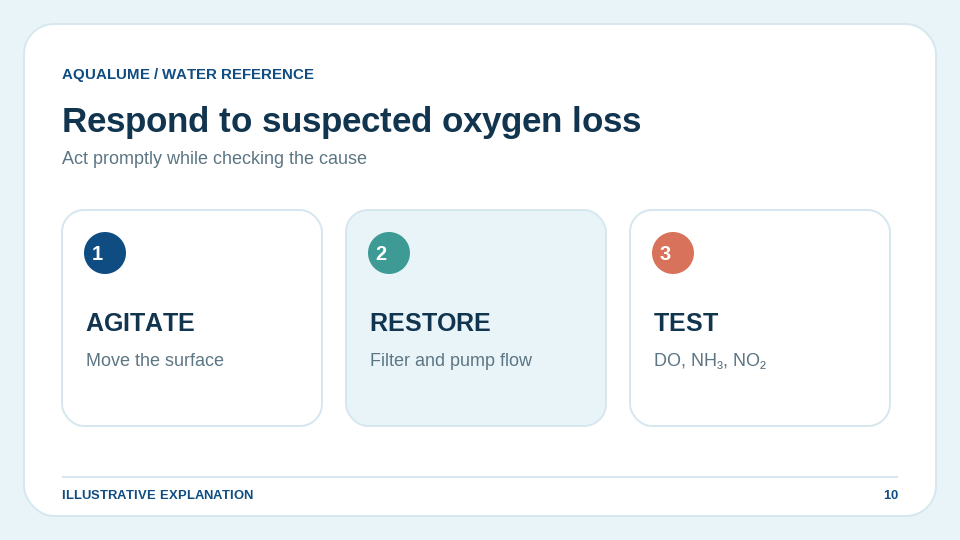
If several fish suddenly gasp, act while you investigate. A suspected oxygen shortage can worsen quickly, especially in warm, densely stocked water. The following sequence supports gas exchange and looks for other urgent causes at the same time.
- Increase surface movement immediately. Direct working flow toward the surface without blasting fish.
- Restore circulation. Check power, pump operation, a clogged intake, and blocked outlets.
- Add supplemental aeration. Use an air stone or backup aerator if available.
- Check temperature. Correct excessive heat gradually; avoid abrupt chilling.
- Test ammonia and nitrite. Gasping may reflect water-quality injury rather than DO alone.
- Check demand. Remove dead animals and decaying matter; investigate blooms or a recent treatment.
- Pause unnecessary feeding. Avoid adding more waste while conditions stabilize.
- Address confirmed water-quality problems. Use properly conditioned, temperature-matched water and appropriate husbandry where indicated.
Do not
- Ignore persistent rapid breathing after flow is restored.
- Assume visible bubbles prove adequate dissolved oxygen.
- Rapidly chill tropical fish.
- Diagnose oxygen alone while overlooking ammonia, nitrite, CO₂, or gill health.
Dissolved Oxygen in Planted Aquariums

During the light period, healthy plants may add O₂ through photosynthesis. Plants also respire continuously, as do fish, shrimp, and microbes. Once lights go out, photosynthesis stops while consumption continues. In a densely planted tank, DO can be lower just before lights turn on than during the afternoon. That timing makes an early-morning measurement more informative than an afternoon-only check when investigating low oxygen.
| Day | Night |
|---|---|
| Photosynthesis may add oxygen | Photosynthesis stops |
| Plants still respire | Plants continue respiring |
| DO may rise during strong photosynthesis | DO may decline toward morning |
Injected CO₂ complicates the picture because aquarists sometimes restrict surface movement to conserve it. Do not eliminate gas exchange to save CO₂ if fish appear distressed or testing suggests poor oxygenation. Balance circulation and injection, monitor livestock, and reassess at night. A planted tank is a changing biological system, not a permanent source of oxygen simply because it contains greenery.
Freshwater vs. Saltwater DO

Salinity lowers the amount of oxygen that can dissolve at the same temperature and atmospheric pressure. At about 25°C, saturated seawater can contain roughly 20% less oxygen than comparable freshwater. Both systems still depend on a working water–air interface and circulation to replenish what animals and microbes consume. Therefore a freshwater mg/L reference should not be copied mechanically as a universal marine target.
| Factor | Freshwater | Saltwater |
|---|---|---|
| Oxygen solubility | Higher under equal conditions | Lower because of salinity |
| Temperature | Warm water holds less | Same general relationship |
| Surface exchange | Essential | Essential |
| Circulation | Important | Important |
Marine aquariums often use strong water movement and, where appropriate, protein skimming as part of gas exchange and circulation. Those devices do not replace an actual DO reading when a problem is suspected. Interpret the reading with salinity, temperature, species, and equipment performance in view. A UF/IFAS saturation table shows the temperature and salinity relationship.
Common Dissolved Oxygen Myths

Several shortcuts sound plausible but hide the mechanisms that matter. Use this table to check the claim against what you can observe or measure.
| Myth | Fact |
|---|---|
| Lots of bubbles always mean high oxygen | Surface exchange and circulation matter more than bubble count. |
| Clear water must be oxygen rich | DO is invisible; clear water can still test low. |
| Plants always increase oxygen | They can produce O₂ in light but respire day and night. |
| Every tank requires an air pump | Effective filtration and surface movement can also oxygenate water. |
| Gasping proves oxygen shortage | Ammonia, nitrite, CO₂, heat, or gill trouble may also cause it. |
| More oxygen is always better | Seek suitable, stable conditions instead of chasing an arbitrary maximum. |
Visible clues can tell you where to investigate, but they do not replace a measurement or a review of the whole aquarium. The most useful question is whether oxygen supply, circulation, and biological demand remain in balance for the species kept.
Frequently asked questions
Aquarium Oxygen FAQ
Use these answers with species-specific care information and actual tank observations.
What is dissolved oxygen in aquarium water?
It is free O₂ gas dissolved among water molecules, available for fish, invertebrates, and aerobic microbes to use. It differs from the oxygen chemically bound in H₂O. A tank gains it mainly through exchange at the water surface and, in lighted planted tanks, through photosynthesis. Animals, plants, microbes, and decomposition continually use some of the supply.
What is a good dissolved oxygen level for a fish tank?
For many freshwater community tanks, roughly 7–8 mg/L is a useful well-oxygenated reference. It is not a mandatory target for every species or setup. Requirements depend on temperature, salinity, activity, life stage, stocking, and exposure time. Read a result alongside fish behavior and the tank's normal trend, and follow species-specific guidance where available.
Is 5 mg/L enough for aquarium fish?
Some fish may tolerate around 5 mg/L, but the safety margin is smaller and sensitive fish may already be stressed. One reading does not reveal how long the level has been low or whether it falls further before morning. Check circulation, temperature, biological demand, and livestock behavior, then improve conditions if the pattern points toward inadequate oxygen.
How do I know if my aquarium has low oxygen?
Watch for fast breathing, fish gathering by outlets, reduced activity, or repeated surface gasping, particularly across multiple fish. Those signs justify prompt attention but are not proof of low DO. A calibrated meter or suitable test provides a more direct answer. Also test ammonia and nitrite, check temperature and CO₂ use, and inspect filter flow and recent changes.
What is the fastest way to increase oxygen?
Increase surface agitation and restore water movement immediately. Point a working outlet toward the surface, clear a blocked filter, or add an air stone or backup aerator. Circulation helps distribute the oxygenated surface water. At the same time, check temperature and water quality so the underlying cause is addressed; an aerator cannot correct every problem on its own.
Do air stones actually add oxygen?
Yes, they can improve oxygenation, mainly because rising bubbles lift water and disturb the surface, promoting gas exchange. Some gas can transfer directly from bubbles, but bubble count alone does not show how much DO the fish receive. Placement, circulation, tank shape, surface condition, temperature, and demand all influence the outcome. Test when the situation is uncertain.
Can aquarium plants provide enough oxygen for fish?
Do not assume so. Plants may produce oxygen under adequate light, yet they and the rest of the tank continue to respire in darkness. A heavily planted aquarium can have its lowest DO shortly before the lights turn on. Maintain suitable gas exchange and circulation even with healthy plants, especially when CO₂ injection, dense growth, or heavy stocking is involved.
Does warm water contain less oxygen?
Warm water has a lower oxygen saturation capacity than cooler water at the same pressure and salinity. At sea level, approximate freshwater saturation falls from 9.1 mg/L at 20°C to 7.5 mg/L at 30°C. These are physical capacity figures, not care targets. Warm conditions may also increase biological demand, making stable circulation especially important during heat waves.
Should I turn off aeration at night?
Not automatically. In planted tanks, photosynthesis stops after dark while fish, plants, and microbes keep using oxygen; the low point may arrive near morning. If the aeration or filter movement supports safe gas exchange, switching it off can reduce the overnight margin. Base the decision on the tank's livestock, flow, CO₂ schedule, and measurements rather than a fixed rule.
Can too much oxygen harm fish?
Ordinary aquarium aeration rarely causes harmful oxygen levels; at normal conditions it tends to move water toward equilibrium with air. Unusual gas supersaturation is a different issue and may involve equipment or pressure changes. Do not chase an arbitrary maximum DO number. Aim for appropriate, stable oxygenation and investigate abnormal readings together with fish behavior and equipment operation.
FAQ takeaway
- Look at behavior and equipment, then test when oxygen limitation is plausible.
- Interpret DO with temperature, salinity, and species in mind.
- Protect overnight gas exchange in planted or heavily stocked tanks.
Conclusion
Keep Oxygen Available
Dissolved oxygen is breathable O₂ in water, not the oxygen atom in H₂O. Its concentration reflects both supply and demand: temperature, salinity, and pressure affect capacity; surface exchange and circulation replenish it; fish, plants, microbes, and decaying matter use it. A low reading needs context, and gasping fish need more than a guess. Check circulation, temperature, ammonia, nitrite, and recent changes while improving surface movement.
A well-kept tank is less likely to face an abrupt oxygen shortfall. Maintain reliable flow, stock responsibly, feed moderately, and remove decaying material. During heat waves, outages, or unusual fish breathing, respond early and test DO when possible. The practical aim is stable, species-appropriate oxygenation.
Healthy oxygen habits
- Maintain appropriate surface movement.
- Keep filters and circulation equipment running.
- Watch temperature during hot weather.
- Avoid excess stocking and feeding.
- Remove decomposing waste promptly.
- Investigate unusual fish respiration.
- Test DO when the conditions make oxygen limitation plausible.
Ask Aqualume
Have a Question About Aquarium Water?
Share your dissolved-oxygen question and relevant tank conditions by email.
Further reading
Related Article Topics
 Filtration
Mechanical, Biological, and Chemical Filtration
Understand media roles, filter order, and safe maintenance.
 Algae causes
What Causes Algae Growth in an Aquarium?
See how light, nutrients, waste, plants, and circulation affect growth.
 Water conditions
Aquarium Water Temperature Guide
How temperature affects fish metabolism, oxygen capacity, and stability.
 Equipment
Air Stone vs. Sponge Filter
Compare aeration, circulation, and biological filtration roles.
 Water testing
Aquarium Water Quality Parameters Explained
Understand ammonia, nitrite, nitrate, pH, hardness, temperature, and DO.